Blogs

Americans top financial concerns: retirement, healthcare

Several surveys out in the past week show just how nervous and unprepared Americans are about retirement and especially rising healthcare costs.   

First, a University of Michigan survey concluded that about one in five U.S. households owe more on credit cards, medical bills, student loans and other debts that aren't backed by collateral than they have in savings.

If you have any questions or comments, please email Peter Arnold at parnold@nssta.com.

Nothing’s gonna stop you in these golden years

Financial security during retirement is a serious concern.  For those who have been injured and who may have long-term medical expenses, it’s an especially important concern.

For those worried about retirement security, a structured settlement offers several financial advantages including:

If you have any questions or comments, please email Peter Arnold at parnold@nssta.com.

California, here we come

Julie Brook, Legal Editor at the California Bar’s continuing education website, just posted this interesting blog, “5 Questions to Ask When Considering a Structured Settlement.”  

Her blog is based on information about structured settlements in CEB’s California Civil Procedure Before Trial (chapter 49).  An excerpt:

If you have any questions or comments, please email Peter Arnold at parnold@nssta.com.

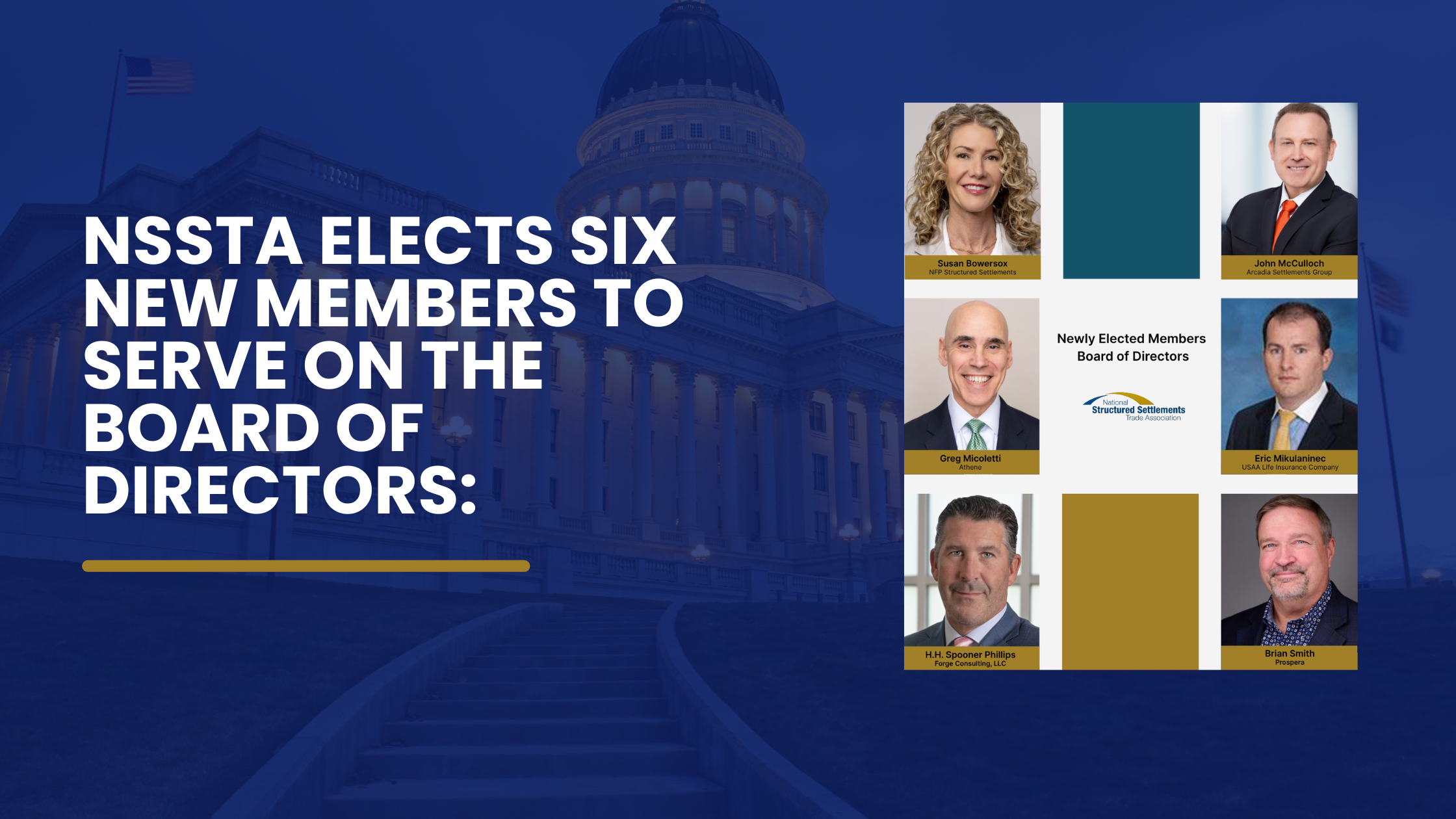
McCulloch, Goodmann join NSSTA Board of Directors

Two longtime structured settlement consultants have been elected to the Board of Directors of the National Structured Settlements Trade Assn. (NSSTA), the association announced today.  The two are:

John McCulloch
Vice President of Advanced Marketing for Integrated Financial Settlements Chicago, IL

Daniel Goodman
Managing Director of Mesirow Financial Structured Settlements Chicago, IL

If you have any questions or comments, please email Peter Arnold at parnold@nssta.com.

“The value of the structured settlement is in holding it… to accomplish a stated goal”

Noreen Seebacher is a well-known business writer and Community Editor at Investor Uprising, a website billing itself as a “no-nonsense guide to global business trends and investment ideas.”  A journalist for more than 20 years, she recently wrote about a major financial decision from 1994: her decision to resolve her daughter’s injury with a structured settlement:

“[Eighteen] years ago, my youngest daughter ended up in an emergency room after threads inside her infant sleeper cut off circulation to her toes….

If you have any questions or comments, please email Peter Arnold at parnold@nssta.com.

Structured settlements & “important legal safeguards”

"Someone considering a structured settlement should appreciate the important legal safeguards for those future payments.  State regulators nationwide have a strong record of enforcing the many consumer protections that help guarantee a structured annuity's financial security.  Our commitment and today's updated laws offer exceptionally effective financial security far into the future.

If you have any questions or comments, please email Peter Arnold at parnold@nssta.com.

Brain injuries & structured settlements

According to a Virginia report this week, a structured settlement helped resolve lawsuits involving two girls injured when a truck ran into the car in which they were riding.  According to the report, the accident left both daughters with brain injuries requiring extensive medical treatment, neuropsychiatric help, and therapy.  For one daughter, the expenses will continue for the rest of her life.

If you have any questions or comments, please email Peter Arnold at parnold@nssta.com.

Major California workers’ comp claim settles with a structured settlement

A severely injured worker in California will receive financial payments for the rest of his life from a structured settlement, as part of what his attorney calls “the highest known workers' compensation insurance settlement in California history.”

If you have any questions or comments, please email Peter Arnold at parnold@nssta.com.

RIP to a "Heavy Hitter"

With great sadness, NSSTA heard this week of the passing of James M. Leary, a longtime structured settlement consultant in Buffalo. For nearly 30 years, Jim was a wise and respected leader in the industry. He owned his own company, Creative Settlements, and served on the NSSTA Board in the 1980s, shortly after this association was established.

Jim also served on NSSTA’s Board of Directors while the association created many of the standard settlement documents still in use today.

If you have any questions or comments, please email Peter Arnold at parnold@nssta.com.

NSSTA Video: Maritime litigation & structured settlements

Under U.S. law, maritime accidents don’t necessarily have to happen on ships or even at sea.  In many cases, maritime injuries can happen on land.  Regardless of where maritime accidents take place, maritime injuries are frequently severe and the resulting litigation can be costly.  

The video features excerpts of a legal seminar given by attorney Charles Leche, senior partner at Deutsch Kerrigan and a nationally recognized litigator on maritime issues.  Named in both The Best Lawyers in America and Louisiana Super Lawyers since 2007, Mr. Leche concentrates on maritime, product liability and mass tort litigation.

Deutsch Kerrigan & Stiles is a nationally prominent firm focusing on maritime law; civil and commercial litigation; and labor, professional liability and environmental law.  The firm has a successful record litigating complex cases before the United States Supreme Court, Fifth Circuit Court, and state courts of Louisiana and Mississippi.

Recognized by Congress since 1982, structured settlements provide tax-free income tailored to the specific needs of an accident victim.  That makes structured settlements well-suited for the needs of many maritime injury victims, who are often severely injured in ways that require years or even a lifetime of care.

Today’s Maritime case law is based on the 1920 Merchant Marine Act (46 U.S.C. § 30104).  In 1920, faced with mounting concerns over compensation of sailors and others injured in maritime accidents, Congress adopted that law, which is often called the Jones Act.  It allows injured sailors to make claims and collect from employers and others due to for the negligence of a ship’s owner, its captain, or the crew.

About The National Structured Settlements Trade Association

Since 1985, the National Structured Settlements Trade Association (nssta.com) has been the leading voice of the structured settlement industry.  NSSTA’s membership includes nearly 1,200 licensed insurance brokers, attorneys, insurance officials and others involved in establishing structured settlements to resolve physical injury, wrongful death and workers' compensation claims. Recognized by Congress since 1982, structured settlements provide long-term, tax-free income for accident victims and their families.

Syndicate content